

Dear Mavericks,
“‘Tis the part of a wise man not to venture all his eggs in one basket.”
Miguel de Cervantes penned those prophetic words in Don Quixote over four centuries ago, back in 1605.
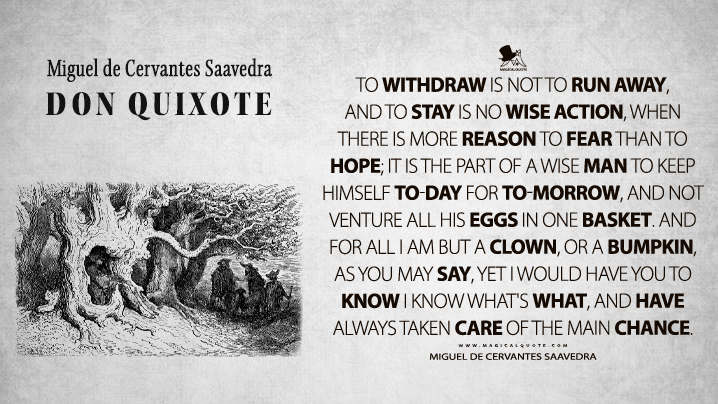
For those who skipped classic literature, the book follows the noble Don Quixote and his bewildered squire, Sancho Panza, as they embark on a series of disastrous adventures. Delusional and desperate for chivalric glory, Quixote famously mistakes mundane windmills for towering giants, decrepit roadside inns for fortified castles, and wandering flocks of sheep for marching armies, inevitably ending each encounter face down in the dirt, bruised, beaten, and humiliated.
Yet out of that madman’s tragicomic hallucinations came the staple gospel for every private banker, retail financial planner, and suburban spreadsheet jockey for the last four hundred years: DON’T PUT ALL YOUR EGGS IN ONE BASKET.
It sounds prudent. It sounds wise. But if you strip away the romantic prose, you realize Cervantes inadvertently wrote the ultimate playbook for the modern institutional investor: a man fighting imaginary monsters on his screen while completely blind to the catastrophic reality bearing down on his actual life.
Fast forward three centuries. Andrew Carnegie, the ruthless steel monopolist, stood before a graduating class of Pittsburgh commercial students and tossed a stick of dynamite directly into Cervantes’ chapel.
“‘Don’t put all your eggs in one basket’ is all wrong,” Carnegie barked. “I tell you, ‘put all your eggs in one basket, and then watch that basket.’ Look around you and take notice; men who do that do not often fail. It is trying to carry too many baskets that breaks most eggs.” Mark Twain loved the quote so much he immortalized it in Pudd’nhead Wilson.
It makes for a cracking cocktail-party debate. The cautious patrician versus the cutthroat industrialist. Scatter your capital, or concentrate your fire?
Except here is the unvarnished truth for October 2026: neither of them considered where the baskets actually sit, nor where the eggs came from in the first place.
Cervantes’ advice sounds solid: diversify to protect against loss. It is the kind of logic that keeps you compliant while the house burns down. But that logic relies on a singular, fatal assumption: that your baskets are actually free to move. In reality, modern diversification is just an illusion of choice. Whether you are holding stocks, bonds, or gold in a domestic brokerage, you are not diversified; you are merely holding different tickets for the same sovereign ride. And when that ride hits a terminal debt cycle, the sovereign does not care which compartment your assets are in. They own the compartment, the basket, and the floor it sits on.
Meanwhile, Carnegie assumed you could build one ironclad basket, fill it with your industry, and watch it like a hawk. He took for granted that the cash-starved sovereign standing behind you would not casually walk up with a club, bash your head in from behind, and confiscate the entire basket to service its unpayable national debts.
The point being: in the thick of this Fourth Turning, jurisdiction matters. Arguably, it is the only thing that matters.
Modern investors spend their lives agonizing over which paper eggs to slip into which digital sleeve. They balance tech equities against government bonds, sprinkle in a dividend ETF, add a dash of spot crypto, and look at their brokerage portal feeling smugly diversified. All of it sits inside their supposed Western safe-house. Weimar, Zimbabwe, Argentina, Cyprus, Russia, the list of capital graveyards is endless, yet the refrain never changes: It won’t happen here. We’re Western. We have the rule of law. Their internal Press Secretary whispers the same lie: Diversification manages my risk; I’ll just wait it out in the bunker.
They haven’t diversified a single thing.
They have simply bought ten different ticket classes on the exact same sinking Titanic. Every single one of their assets shares the same legal code, the same predatory tax authority, the same debasing currency, and the same centralized clearinghouse that can freeze their capital with a single keystroke.
At Mavericks, we have zero interest in trading paper eggs in a rigged casino. We don’t want the basket. We want the chicken itself; in fact, we want to own the entire damn farm.
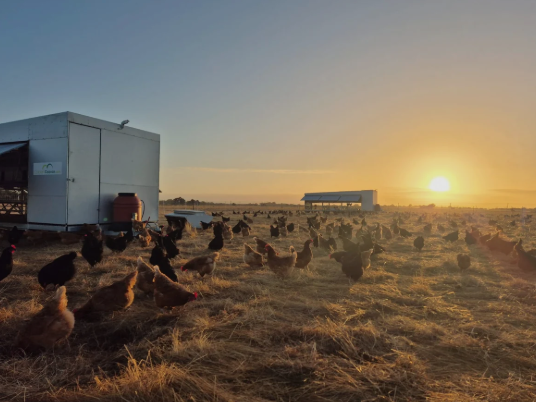
And most critically: we make damn sure that farm sits well outside the domestic sovereign’s fence.
Note: If you havent read it, go back and peruse NL #15 – The Architech of your Cage, it sets the scene for this little diddie, nicely!
Let’s dig in.
Section I: The Single Room Trap (The Illusion of the Sovereign Safe-House)
Take a look at the balance sheet of the average successful Western operator today. By every metric taught in business school, preached by private wealth advisors, or validated on family office panels, this individual looks completely bulletproof.
He, she or “they”, owns his primary residence (let’s hope – free and clear) in Sydney, Surrey, Toronto, or Austin. Down the coast, he has a vacation home or a lucrative short-term rental pulling strong seasonal cash flow. Perhaps he even branched out into passive property plays, parking excess liquidity into commercial syndications or a sunbelt multifamily real estate investment trust.
He runs a profitable domestic business, draws a healthy executive income, and faithfully maxes out his tax-advantaged retirement accounts, whether that is a 401(k), an Australian self managed superannuation fund, a British self-invested personal pension, or a Canadian registered retirement savings plan.
He has even taken precautions against monetary debasement. He doesn’t just own paper claims; he holds physical gold and silver. To mitigate counterparty risk, he has split the physical bullion across multiple locations: a discreet safe buried in his backyard, a safety deposit box at a regional bank, and an allocated stash sitting inside a private depository in Texas, Melbourne, or London.
Finally, there is the liquid portfolio, the crown jewel where textbook modern portfolio theory comes to life. He laughed off the stale 60/40 balanced fund long ago. Instead, he opened an account with a global brokerage platform like Interactive Brokers. He holds an indexed base of broad equities, overlays an allocation to high-growth technology names, maybe even a bite at SpaceX, and he adds global dividend payers, and sprinkles in asymmetric commodity bets and resource producers. To top it off, he self-custodies a modest stack of Bitcoin on a cold-storage hardware wallet tucked inside his desk drawer.
Ask this man if he is diversified, and he will look at you like you have lost your mind. He has dozens of baskets, dozens of asset classes, physical hedges, digital plays, real estate, cash flow, and equity upside. He believes he has engineered a masterclass in resilience. Carnege would argue he’s at risk of tripping over his baskets!
But ask yourself, really ask yourself: how diversified is he?
He has constructed an elaborate, ten-compartment storage chest and placed it dead center inside a single, heavily mortgaged room.
Every single asset class, custody point, account number, title deed, and tax identifier he controls is pinned to one single flag. His primary home, his holiday rental, his business, his bank accounts, his domestic gold depository, his domestic pension wrapper, and his fully allocated brokerage account are all tethered to the sovereign authority of one bankrupt nation.
If that sovereign catches a fiscal fever, the ten compartments cease to matter. The state does not audit or seize compartment by compartment; it exercises total administrative jurisdiction over the room itself.
To believe this provides safety is to suffer from a catastrophic failure of imagination. It relies on the childlike faith that your domestic jurisdiction is an unassailable safe-house, a polite, rules-based oasis immune to the historical laws of sovereign insolvency.
The Western operator looks at the historical wreckage of Weimar Germany, Peronist Argentina, modern Zimbabwe, or Cyprus in 2013, and their Press Secretary immediately serves up the narcotic of exceptionalism: That is a third-world tragedy. That happens in corrupt backwaters. It cannot happen to us. We have the rule of law. We have Magna Carta. We have private property rights.
If you still believe that fairy tale, look at what is unfolding across the Western banking grid right now.
We’ve fielded dozens of identical calls from members across Australia, New Zealand, the Eurozone, Canada and yes, even the good-ole U.SofA; they’re all attempting to execute routine cross-border transfers into private, hard-asset allocations. These are not illicit trades; they are fully documented movements of private, post-tax capital.
The pattern never varies. Transfers flagged without cause. Urgent, automated RFI’s (requests for information) demanding three decades of tax returns to justify routine six-figure remittances.

Had a great story the other day; whilst trying to pay his state prison fees, (I mean tax bill), his bank flagged the payment as a RFI, demanding to know both source of wealth and purpose of payment. It’s like being beaten by the prison guard and the lawyer who’s visiting you, at the same time! Payment was in limbo for months trying to convince the bank, that the tax department had demanded the payment!
You see, in every instance, the process follows the same routine; accounts are summarily terminated under the opaque banner of an institution’s internal risk appetite. Capital left stranded in bureaucratic purgatory for months on end while compliance algorithms, or worse a mid-level “Compliance Officer” decides whether an individual is permitted to move their own accumulated savings outside the wire.
These investors invariably started in the exact same place: convinced that warnings about capital controls were hyperbolic doom-mongering. Then the algorithmic guillotine dropped on their own balance sheet.
At that threshold, human psychology fractures into two distinct responses. The first is the awakened operator: he feels the friction, realizes the walls are closing in, and moves with aggressive urgency to extract the rest of his wealth before the exit door bolts completely. The second is the institutionalized deer: paralyzed by the headlights, he throws his hands in the air and complains that the bank has made the process too exhausting, quietly surrendering his agency and resigning himself to the cage.
In fact it is right here, where in NL #15, section 4, where we showed you the way out of the cage; one “small” step at a time. Don’t do it all at one, just take a single small step at first, then let the second one follow!
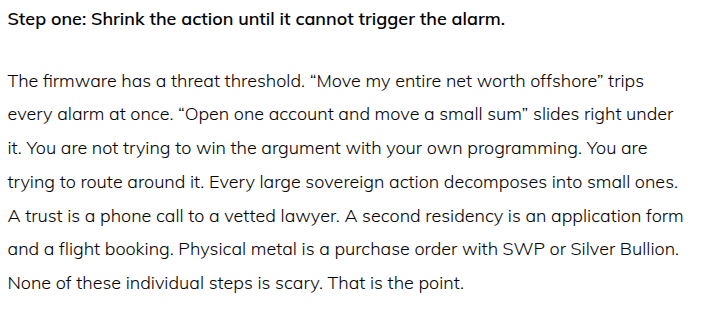
And beleive you me! I’ve had the very discussions, (with Mavericks members) whom suggest, we’re a little hyperbolic as-to the risks of Capital Controls! Please understand the mechanics of the trap: capital controls in 2026 do not arrive via midnight radio broadcasts or tanks parked in front of central banks. They arrive dressed as anti-money laundering updates, enhanced customer due diligence, automated transaction surveillance, the Common Reporting Standards and Scandinavian de-risking protocols. Data from banking ombudsmen across the Commonwealth and Europe shows unprovoked account closures and cross-border payment rejections reaching multi-decade highs.
The direction of travel is undeniable. Your domestic liquidity is an administrative illusion. When your currency, your title deeds, your broker, and your bank accounts all answer to the same desperate state, you are not holding a diversified portfolio.
You are holding a single ledger, and the sovereign holds the red pen.
Section II: The Stage 6 Playbook (Ray Dalio and the Mechanics of the Squeeze)
This is not speculation, nor is it a novel feature of modern central banking. It is the predictable, mechanical sequence of the Big Cycle.
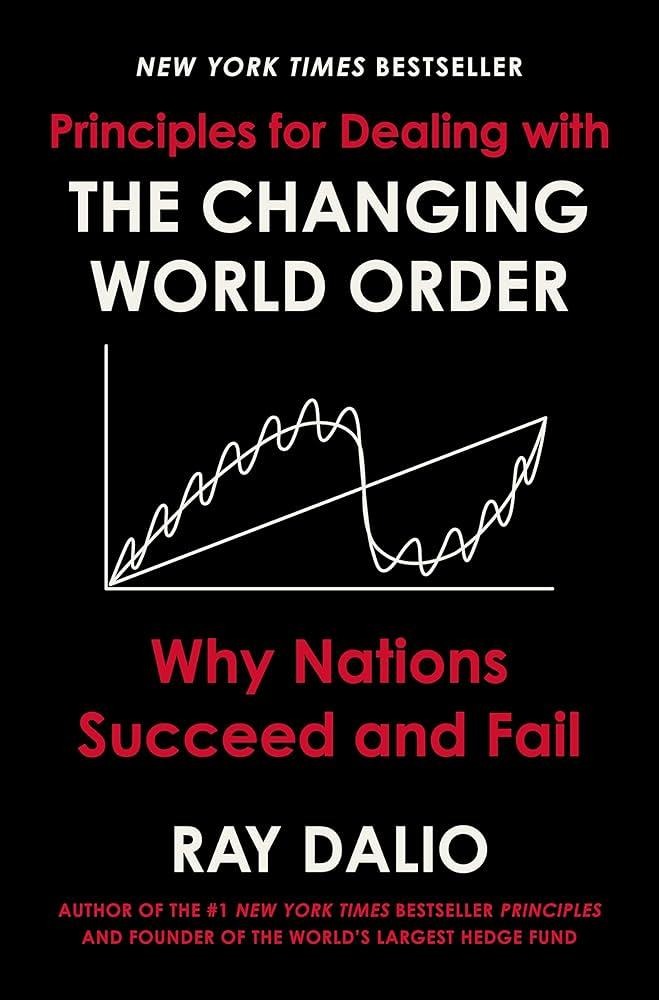
Ray Dalio spent decades systematically dissecting the rise and fall of the Dutch, British, and American empires in Principles for Dealing with the Changing World Order.
What his historical models prove beyond argument is that when debt-to-GDP crosses the threshold of arithmetic impossibility, societies do not magically innovate or austerity their way back to solvency. They enter Stage 5, and rapidly degenerate into Stage 6: the period of open financial repression, societal fracture, and outright balance sheet liquidation.
Look at the mechanics of the trap as Dalio defines it:
First, debt service outstrips the productive tax revenue of the real economy. When the interest payments alone consume a quarter of federal tax receipts, and rollover requirements measure in the trillions, the state faces a binary choice. It can either default openly, blowing up its own banking system, or it can run the central bank’s printing press at maximum throttle to monetize the deficit.
Every dying empire chooses the printing press. It is the path of least political resistance.
Second, the currency begins to reprice against the physical world. Gold goes vertical. Commodities break through historic multi-decade resistance bands. Everyday essentials become luxury goods. The general public, lacking the financial literacy to diagnose monetary debasement, blames price gougers, greedy landlords, and foreign adversaries. Domestic wealth inequality widens into a chasm. The political class divides into tribal factions, populism metastasizes, and internal conflict boils over.
Then comes the pivot that the comfortable Western investor never prepares for: Stage 6.
When the sovereign can no longer borrow honestly, and when printing more paper currency threatens to trigger runaway inflation, the state turns inward. It looks across its domestic pasture and identifies the accumulated private wealth of its own citizenry not as inviolable private property, but as the final pool of unharvested liquidity required to perpetuate its own survival.
As Dalio explicitly documents, the playbook in Stage 6 never alters across centuries:
The state does not ask for permission. It enacts capital controls to trap wealth inside the fence. It rolls out emergency windfall taxes on energy producers and landlords. It proposes taxes on paper gains, unrealized asset appreciation, and inherited estates. It passes forced-investment mandates, quietly compelling domestic pension funds, insurance providers, and retirement accounts to absorb unsellable tranches of low-yielding sovereign debt.
Now pause for a second, clear away the daily political theater, and ask yourself: does any of this sound familiar?
Take an unblinkered look across the Western bloc right now. The inward turn is not a future threat; it is already the law of the land.
Look at the United Kingdom summarily tearing up centuries of common-law tradition to abolish the non-dom regime, actively trapping and penalizing global capital that once considered London a sanctuary. Look at Canada ratcheting up capital gains inclusion rates and tightening the screws on deemed disposition exit taxes to ensure departing entrepreneurs leave a massive pound of flesh at the border. Look at Australia passing retrospective changes to superannuation tax concessions and aggressively tightening capital gains discounts to siphon billions out of private retirement pools. Look at the Netherlands openly advancing wealth taxes on unrealized paper returns.
The sovereign has stopped pretending to manage an economy. It is raiding the pantry.
This is the cold reality every investor must understand: in Stage 6, holding your assets inside the jurisdiction where you live transforms from a convenience into an existential risk.
The state does not need to dispatch marshals to seize your property. In a modern administrative bureaucracy, confiscation is entirely digital. It takes place through the stroke of a regulatory pen, an adjusted tax tier on your mandatory retirement dashboard, a punitive exit levy on international wire transfers, or an algorithm that locks your account until you prove you have paid the latest solidarity surcharge.
You can shout about the rule of law until your voice gives out. You can wave the constitution or quote the common law. But the historical law of sovereign insolvency outranks domestic statute every single time.
When the arithmetic breaks, the polite contract between the state and the citizen dissolves. The sovereign does not negotiate with the balance sheets in its yard; it feeds on them.
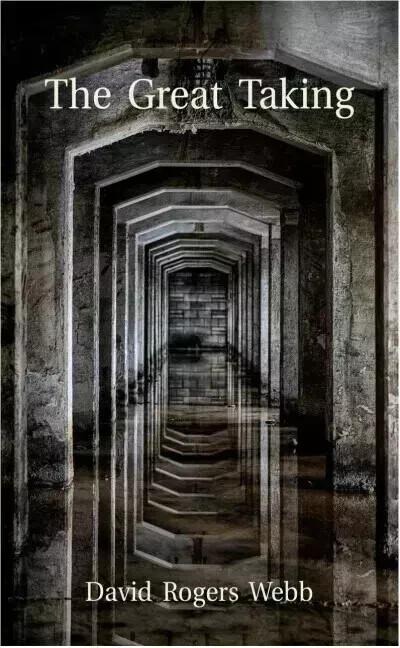
This, my friend, is The Great Taking.
It will not arrive as a neat, cinematic climax like watching The Big Short. It rolls in like a slow-moving front, dressed in the illusionary protection of our trusted institutions, quietly consuming you. It erodes your accumulated wealth, your living standards, and your lifestyle inch by administrative inch, while you exhaust your remaining energy screaming at the latest policy blunder on your screen.
Stop waiting for the event, and start to take action before the front turns into a full blown storm!
Section III: The Capital Gains Alibi (The Press Secretary’s Favorite Trap)
Earlier today, I had a conversation that plays out almost weekly. An experienced investor walked me through his portfolio. He holds a significant balance sheet, built meticulously over a decade through a mix of domestic equities, private companies, and managed accounts.
He sees the macro trajectory clearly. He acknowledges Dalio’s debt cycles. He understands that the banking system is an administrative trap. But when the conversation turns to moving capital offshore and structuring assets beyond the reach of his home government, he hits a wall.
His argument was entirely predictable: “If I sell my positions to move capital offshore, I trigger a massive taxable event. I have five to ten years of accumulated capital gains. I’m looking at a twenty-five or thirty percent haircut immediately. Why on earth would I take a guaranteed thirty percent loss today just to send money to an unfamiliar jurisdiction for unknown returns?”
He leaned back, satisfied that he had delivered an unassailable financial argument.
And in a normal, functioning world, he would be completely right.
If you are operating in the post-WWII golden age of institutional trust, or navigating the forty-year debt supercycle between 1982 and 2022, optimizing for tax efficiency is sensible stewardship. In that peacetime environment, you defer taxes as long as possible, compound every basis point inside tax-advantaged wrappers, and treat tax avoidance as your highest financial duty.
Except that world is dead.
What this investor failed to grasp is that his argument was not financial analysis. It was his internal Press Secretary delivering a brilliant, respectable rationalization for paralysis.
Think through the math of his position: he is willfully risking one hundred percent of his accumulated capital inside a domestic legal jurisdiction entering Stage 6 confiscation, solely to avoid paying a twenty-five percent exit toll today. He is literally standing on the upper deck of a vessel taking on water, loudly negotiating the price of the lifeboat.
He assumes that his twenty-five percent tax liability tomorrow will still be twenty-five percent. He assumes the state will not double the inclusion rate, levy an emergency wealth surtax, or simply deem his retirement assets captive to domestic infrastructure bonds. You see, we move very quickly from a world where the institutions tell you where you can-not invest, to where you MUST invest! As bonds go no-bid, watch the regulators scream for private capital to foot the bill!
Most absurd of all, the assumption is that when the crisis peaks, one will still be allowed to click a button and wire his remaining seventy-five percent across the border without interference.
This is not prudence. It is a slow-motion surrender to dispossession.
The cost of moving capital is real. Friction exists. Taking a realized tax hit hurts. But you must ask yourself what you are actually buying: are you looking for an investment return, or are you buying structural survival?
A seat on a sovereign lifeboat does not come free. The fee you pay to extract capital today is not an expense; it is the price of purchasing a life raft before the vessel rolls over.
Section IV: Forward Provisioning & The Farm Outside the Fence
So how does a rational operator break this deadlock?
You abandon the consumer mindset and adopt the operator protocol. As our good friend and Maverick engineer of GunBay Global Advisory, Dr. Mots puts it, you engage in Forward Provisioning.
In military logistics and sovereign supply-chain management, forward provisioning means placing critical resources, fuel, ammunition, and equipment in secure, geographically strategic positions long before hostilities begin. You do not wait for the war to break out and then try to source supplies through contested shipping lanes. You position them ahead of time, quietly and deliberately, so that when the supply lines snap, your operational capacity remains uninterrupted.
Apply that exact logic to your family’s balance sheet:
You do not liquidate your entire life tomorrow morning in a panic. You do not sell every domestic asset and jump blindly into the unknown. That is an emotional reaction.
Instead, you forward-provision an unencumbered portion of your wealth. You absorb the friction, settle the domestic tax toll on that tranche, and extract it completely from your home sovereign’s orbit. You place that capital into an audit-proof, tax-neutral offshore container, holding physical matter, productive capacity, and sovereign treasury reserves.
Then you let it sit. Then wash rinse repeat! This is a process, play it out, step by step, whilst staying ahead of the game.
You treat this as your “Just In Case” position. You hope the system miraculously repairs itself. You hope the debt arithmetically dissolves. You hope you never have to lean on that offshore redoubt.
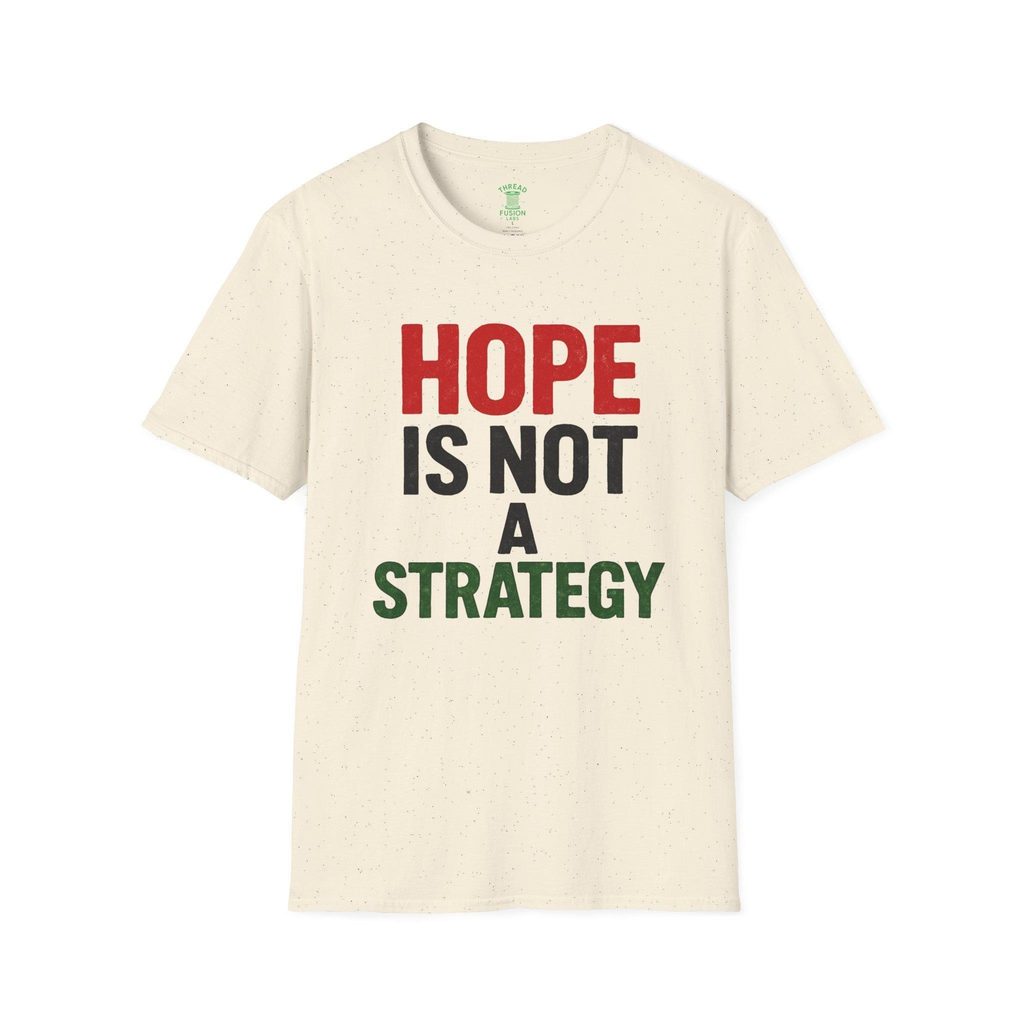
But as we remind ourselves daily: hope is not a strategy!
This brings us back to Cervantes and Carnegie.
We discard Cervantes’ naive advice of scattering paper tickets across ten compartments of a single domestic room. We also reject Carnegie’s gamble of keeping all our eggs in one domestic basket and praying the state doesn’t smash it with a hammer.
The 2026 Maverick Playbook synthesizes focus and sovereignty:
- Own the Chicken and hec, own the whole Farm: Reject the paper casino. Concentrate your capital into the physical Matter Economy—productive agricultural land that feeds populations, conventional energy extraction that powers industrial baseloads, and physical precious metals that hold permanent monetary value through currency resets. You do not want a digital claim on a balance sheet; you want direct ownership of physical production.
- Lock the Gate Outside the Fence: Ensure the legal title, corporate custody, and banking rails governing that production sit far beyond the administrative reach of your domestic sovereign.
True diversification is never about owning twenty different ticker symbols on a screen.
True diversification is having your legal structures in one neutral jurisdiction, your physical assets operating in a resource-rich production corridor, your banking rails clearing through sovereign counterparties, and your personal residence in a nation that views you as an asset to be welcomed, rather than a line item to be liquidated.
You cannot protect your wealth by rearranging deck chairs inside the wire.
You protect it by moving your footing entirely outside the sovereign’s perimeter.
THE MAVERICK DIRECTIVE: WHAT NOW?
Reading the map is useless if you never leave the terminal. The purpose of this community is not to sit around trading sophisticated complaints about the decline of the West; it’s to build the physical and legal architecture to survive it. And importantly to do it now!
Here is how you execute:
1. Events & Meetups: The Ground Game
- Argentina Investor Site Tour (December 1–5, 2026): We are heading back down to the source. This is a boots-on-the-ground operational inspection of our active projects across the Rio Negro valley and the Vaca Muerta basin. Due to logistics, access is restricted strictly to active project investors. Keep an eye on your inbox for the formal invitation and operational itinerary dropping shortly. (Note: If you have not yet deployed capital into the pipeline but have serious intent and wish to inspect the assets firsthand, email us directly at admin@mavericksproject.org).
- Portugal Social BBQ (Sunday, October 31, 2026): Final call. We have roughly fifteen local and visiting Mavericks gathering in Colares, just outside Lisbon, at the world’s westernmost winery for an unscripted afternoon of local wine, grilled meat, and sanity. If you are in the region and want to pull up a chair, get in touch immediately to coordinate with the local node. Join the Signal group.
- Mavericks Global Summit 2027 (Florida — First Half of April 2027): Mark your calendars. We are returning to the Americas for our next flagship gathering in early April. We will begin teasing out the location, operational themes, and speaker lineups over the coming issues.
- GunBay Global Annual Meetup (July 9–10, 2027 — Grand Cayman): Following the success of our July gathering, the date for the 2027 offshore summit is officially locked in. Two full days dedicated to private treasury management, cross-border legal structures, and sovereign deployment. You can view the confirmed framework and save the date directly on the calendar here.
2. Mavericks Social: Step Out of the Lurker Box
Activity across our private platform has ebbed over the last month, which usually means people have drifted back into daily domestic fog. The forum is only as valuable as the collective intelligence fed into it. Stop lurking and start engaging:
- @apf continues to drop real-time field reports, regulatory updates, and background intelligence regarding our active Argentine projects.
- @hajes29a recently posted a high-signal framework on prudent investing and generational wealth-building strategies. It currently has zero comments. Jump in, review the methodology, and push back or add your experience.
- The Mavericks Tech, Online Privacy & Security Group remains our most active operational node. If you have not migrated off mainstream surveillance platforms or audited your hardware stack, the steps are laid out there in black and white.
Log in, search the archives, and contribute your recon.
How to Join Mavericks Social:
If you have not yet set up your credentials on our private, privacy-first platform, follow these four simple steps:
- Ensure you are logged into the main portal at www.mavericksproject.org.
- Navigate directly to the forum signup URL: https://mavericksproject.org/forum/.
- Watch the brief introductory orientation video on the landing page.
- Directly below the video, enter your desired community handle and password. Clicking submit will automatically generate your encrypted profile and redirect you to https://social.mavericksproject.org/. From then on, simply log in using your registered Mavericks email and chosen password.
3. GunBay Global Advisory: The Operational Crowbar
NL #15 diagnosed the internal prison.
This issue laid out the mechanics of the jurisdictional trap.
GunBay is the tool built to solve it.
Think of GunBay Global Advisory as a dedicated multi-family office container engineered specifically for the Maverick mindset. It provides an audit-proof, tax-neutral offshore investment structure designed to hold sovereign capital, manage treasury reserves, and route liquidity directly into private hard-asset allocations without needing permission from domestic clearinghouses.
We hosted a closed-door briefing walking through the exact mechanics of the structure, treasury management, and how this container shields capital from Stage 6 predation.
If you missed the live session, you can watch the webinar replay here.
4. Subvertere Capital: The Matter Economy Pipeline
While institutional investors continue to chase digital paper at historical multiples, our boots-on-the-ground pipeline in South America continues to translate capital into physical production:
- Añelo Oasis (Vaca Muerta Housing): Concrete foundations are poured. Structural steel framing commences on-site next week. The engineering crew is running on schedule to have the initial residential blocks fully habitable in time for our investor delegation to stay on-site during the December tour.
- Riverland Ag (Food & Farmland): We are finalizing closing documentation to settle on an exceptional 3,000-hectare mixed-cropping and beef cattle property in the Entre Rios provence. This site represents the core of our farmland thesis and will be a major operational stop on our December itinerary.
- Terra Oil (Conventional Energy): Active due diligence continues. The technical team has screened dozens of energy related opportunites, identifying cash-flowing, overlooked extraction assets that fit our strict low-breakeven criteria. More news on this front shortly.
5. Strategic Partners: Sovereign Custody Outside the Wire
Do not keep your physical hedges inside the domestic banking system. If your gold sits in a bank safe deposit box or a domestic ETF, it remains fully exposed to the sovereign’s red pen.
- SWP Cayman — Annual Gold Rush Returns: Our long-term partners at Strategic Wealth Preservation (SWP) in Grand Cayman are running their flagship promotion for the fourth quarter. From October 1 through midnight December 31, 2026, every client (new or existing) who purchases and stores a minimum of $25,000 in physical gold directly within their non-reporting Cayman vault receives an entry into their annual Gold Rush draw (scaled at one entry per $25,000 allocated). This promotion runs concurrently with any existing member arrangements. Reach out to your SWP account representative to coordinate.
- Silver Bullion (Singapore): For those seeking dedicated vaulting nodes throughout Southeast Asia, our partner arrangements with Silver Bullion in Singapore provide private, non-bank, fully segregated physical custody outside Western legal entanglements.
We are also actively building out a vetted roster of cross-border legal, structuring, and accounting specialists who understand how to legitimately decouple assets from high-tax regimes. If you are ready to move past theoretical research and need direct introductions, ping us at admin@mavericksproject.org with your operational requirements.
THE FINAL WORD
The myth of the single vault is comforting right up until the sovereign turns the key.
You can continue to believe that your ten compartments in a single domestic room constitute a hedge, or you can face the historical laws of sovereign insolvency and start forward-provisioning your capital into the physical world.
Own the chicken. Own the farm. Lock the gate far beyond the domestic fence.
Take the first step. Let the second one follow.
Build what lasts.
—
Chris & Andrew
Mavericks HQ